Hybrid Work in 2026: Why Companies Are Splitting Teams Across Coworking Hubs
- July 21, 2026
- 0 Comments
The debate about “returning to the office” is effectively over.
In 2026, hybrid work isn’t a concession or an experiment — it’s the operating model of the modern economy. And a specific version of it is reshaping how companies think about physical workspace: splitting a single team across multiple coworking hubs instead of concentrating everyone under one roof.
Ask a founder or ops lead in the Tricity today and you’ll hear the same pattern: some team members work from Chandigarh, some from Mohali, a few from Zirakpur or Panchkula. Nobody wants a full daily commute. But home is not a professional workspace either — unreliable internet, family interruptions, no space for client calls.
Companies are solving this with what real estate analysts now call the “hub-and-spoke” model — a smaller core HQ (or none at all) combined with a network of coworking hubs closer to where employees actually live.
This blog explains why the shift is happening, how it works in practice, and how IDEA Co-Working powers it across the Tricity.
Four numbers tell the story:
Hybrid work is no longer a perk. It’s a growth strategy.
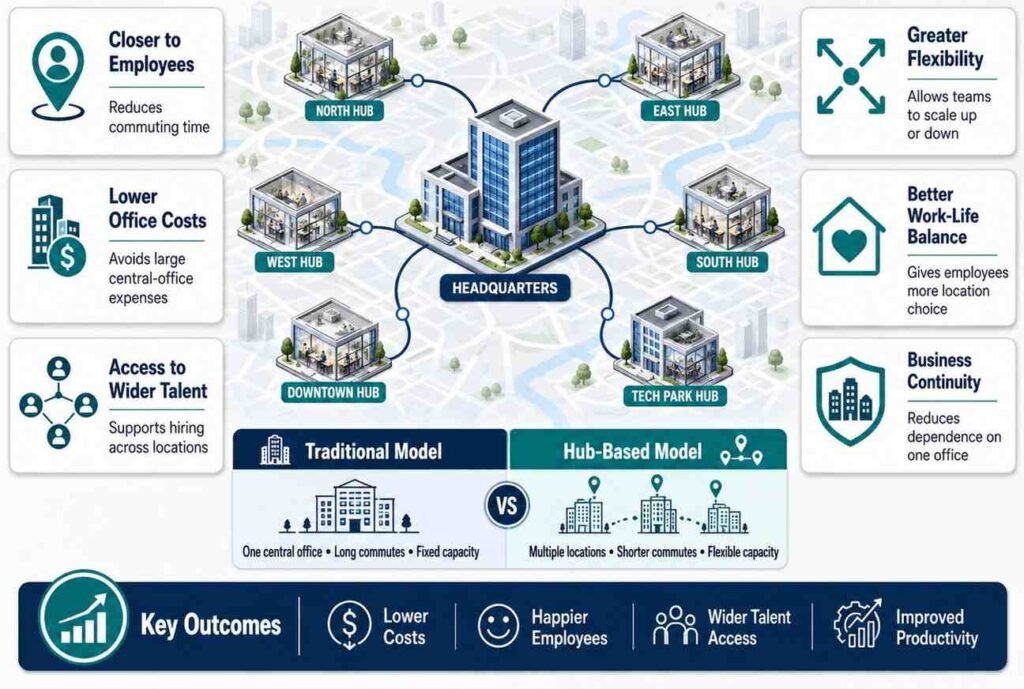
The rationale is practical, not theoretical:
The best engineers, designers, and operators no longer relocate for a job. Companies now meet talent where it is — which means a Bengaluru-HQ firm hiring a senior developer in Mohali needs to give that developer a workspace in Mohali, not Bengaluru.
An employee losing 2–3 hours a day to commuting is neither productive nor loyal. A coworking hub 15 minutes from home solves the commute problem without sacrificing a professional environment.
A five-year lease made sense when teams were static. In 2026, headcount fluctuates with product cycles and funding rounds. Coworking hubs let a company scale up or down monthly — not triennially.
Fully remote teams struggle with mentorship, onboarding, and cross-functional collaboration. Hybrid teams working from coworking hubs get the best of both: focused solo work from home, plus in-person collaboration a few days a week at a workspace designed for it.
KEY INSIGHT: Hybrid workers report 61% trust in leadership — higher than either fully on-site (31%) or fully remote employees. Structured hybrid, not the extremes, wins on culture.
Take a hypothetical company with 30 employees distributed across the Tricity. The traditional model: lease 3,000 sq ft in one location. Force everyone to commute daily. Absorb the fit-out cost, the long lease, and the risk.
The hub-and-spoke alternative: private cabins or dedicated desks across two or three coworking hubs. Employees pick the location closest to home. Cross-team collaboration days rotate between locations. Meeting rooms handle full-team offsites when needed.
The outcome: shorter commutes, higher retention, no long-term lease exposure, and a real estate footprint that expands or contracts with the team.
The Tricity is a single functional economic zone with three distinct urban centres. That structure is uniquely suited to the hub-and-spoke workspace model — and IDEA Co-Working operates in all three:
A company with 15–40 distributed employees can offer every one of them a workspace within a 15–25 minute commute — without signing three separate commercial leases or managing three separate operations.
TRICITY ADVANTAGE: One provider. Three hubs. Unified billing. Consistent infrastructure. A distributed team gets professional workspace across the entire Tricity — without three leases, three fit-outs, or three operational headaches.
| What Companies Get With IDEA Co-Working’s Multi-Hub Model Three Tricity locations under one provider — Chandigarh, Mohali, and Zirakpur — seamless coverage 🔒 Private cabins and dedicated desks — for teams that need enclosed, confidential workspace 📊 Bookable meeting rooms at every location — for cross-team collaboration days and client meetings ⚡ Commercial leased-line internet — consistent, high-speed connectivity across all hubs 🔋 100% power backup — uninterrupted workdays at every location 📈 Scale up or down without penalty — add or reduce seats as your team evolves 💼 Single-provider billing — one relationship, three hubs — simplified operations |
If your company already has distributed employees across the Tricity — or you’re planning to hire in the region — IDEA Co-Working can structure your multi-hub presence in a single conversation. One provider, three locations, predictable monthly cost, full flexibility.
| 👉 Book a walkthrough of our three Tricity centres or request a multi-hub plan today 🌐 ideacoworking.com/book-your-space 📞 +91 73411 32601 | 📧 sales@ideacoworking.com Chandigarh (Sector 17-C) | Mohali (Phase 7) | Zirakpur (Peer Muchalla) |
Running a hybrid team in the Tricity? Tell us your team size, distribution, and biggest workspace pain point in the comments — we’ll walk you through exactly what a multi-hub setup would look like for your situation.
The model starts making sense from around 10–15 distributed employees across the Tricity and becomes strongly compelling for teams of 25–100+. Below 10, a single-location plan usually delivers the same benefits with less coordination overhead.
Yes. IDEA Co-Working offers multi-location plans that let a single company allocate seats across Chandigarh, Mohali, and Zirakpur under unified billing. Contact our team for a custom multi-hub configuration.
Yes — subject to your plan structure. Multi-hub plans can be configured to allow team members to work from any IDEA Co-Working location, which is especially useful for meetings, cross-team collaboration days, or when someone happens to be visiting a different part of the Tricity.

